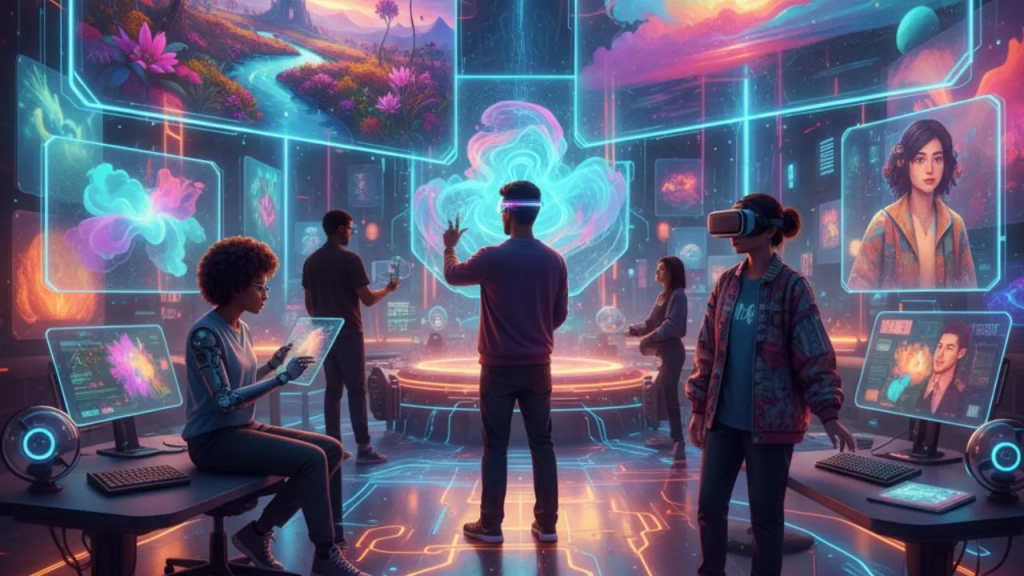
The digital design landscape has underwent a profound transformation. Not long ago, producing high-fidelity visual assets, concept art, or promotional graphics required years of specialized software mastery, complex physical setups, or substantial production budgets. Today, a text prompt typed into a web browser can synthesize stunning, photorealistic imagery, surreal artwork, or intricate vector illustrations in a matter of seconds.
Central to this cultural shift is the accessibility of digital creation tools. The rapid maturation of generative AI algorithms—moving from early experimental networks to highly sophisticated Diffusion Transformers—has lowered the barrier to entry for creators worldwide. Whether you are an independent game developer sketching world concepts, a marketer drafting social media campaign visuals, or a hobbyist exploring digital surrealism, modern web-based generators allow anyone to translate abstract thoughts into high-resolution visuals.
The Technical Core: How Text-to-Image AI Actually Works
To appreciate the speed and precision of modern generation tools, it helps to understand the technical engine powering them. While early synthetic media relied on Generative Adversarial Networks (GANs)—which pitted two neural networks against each other in a game of generator vs. discriminator—today’s state-of-the-art generators primarily rely on Latent Diffusion Models (LDMs) and Diffusion Transformers (DiTs).
The image synthesis pipeline unfolds across three core stages:
Natural Language Understanding
When you enter a prompt such as “A cinematic close-up of an astronaut walking through a neon-lit rain forest,” the system cannot interpret raw English words directly. First, a text encoder (often based on CLIP or T5 architectures) translates the prompt into mathematical vectors known as text embeddings. These embeddings map the semantic relationships between concepts—understanding not just what an “astronaut” looks like, but how “cinematic,” “neon-lit,” and “rain” alter lighting, reflection, and depth of field.
The Diffusion and Denoising Process
Rather than drawing an image from scratch like a painter, diffusion models begin with a canvas of pure static—Gaussian noise. The model is trained to reverse a process of gradual degradation. Guided by your text embeddings through cross-attention mechanisms, the neural network predicts and subtracts noise step-by-step. Over 20 to 50 iterations, random pixel clusters coalesce into coherent shapes, textures, lighting patterns, and fine details.
Latent Space Compression and VAE Decoding
Processing high-resolution images pixel-by-pixel across dozens of steps is computationally massive. Modern tools solve this by operating inside Latent Space—a mathematically compressed representation of an image created by a Variational Autoencoder (VAE). The diffusion network removes noise within this lightweight latent grid. Once complete, the VAE decoder expands the latent output back into a full-resolution pixel file (e.g., JPEG or PNG) ready for download.
From Local Rigs to Accessible Web-Based Workflows
In the early stages of the AI image revolution, generating high-quality art required downloading gigabytes of open-source weights, configuring Python environments, and running expensive desktop GPUs. While local execution remains popular among developer communities, it creates an immense technical hurdle for everyday creatives.
The democratization of the medium has been driven by browser-native, cloud-hosted ecosystems. Users no longer need complex hardware setups; powerful cloud servers handle the heavy mathematical lifting behind simple, intuitive graphical interfaces.
This accessibility shift has sparked a massive wave of integrated web applications. Creatives can generate visuals directly alongside editing suites, enabling instant background removal, canvas extensions, and style transfers without leaving their browsers.
For creators, marketers, and casual users looking to experiment without technical friction, leveraging an intuitive free AI image generator serves as a seamless entry point into professional-grade asset creation. These tools bridge the gap between complex algorithmic backends and user-friendly creative suites, making synthetic media accessible to everyone regardless of hardware limitations.
Practical Applications Across Industries
Generative visual technology has moved far beyond a novelty tool for internet art. It is actively restructuring operational pipelines across commercial and creative sectors:
- E-Commerce & Digital Advertising: Marketers can instantly generate diverse lifestyle environments around product renders without renting studio space, booking lighting crews, or staging locations.
- Entertainment & Pre-Visualization: Concept artists and film directors use rapid text-to-image workflows to build mood boards, explore color palettes, and draft environmental landscapes during early storyboarding stages.
- Web Design & Publishing: Editorial teams produce bespoke article illustrations, banner graphics, and featured headers that match brand colors, replacing generic stock imagery with context-aware art.
Prompt Engineering: Turning Concepts into High-Impact Visuals
A common frustration among new AI users is the “lottery effect”: typing a vague prompt and hoping the model guesses what is inside their head. Because generative models respond to precise spatial, stylistic, and lighting cues, mastering prompt engineering is the single most effective way to improve output quality.
The Four-Part Prompting Framework
- Core Subject: Defines the main focal entity (e.g., “A vintage mechanical pocket watch” or “An arctic fox”).
- Environment & Context: Sets the background, atmosphere, and spatial layout (e.g., “resting on a velvet cloth in an old library” or “blizzard at dusk”).
- Stylistic Medium: Establishes the visual art style or camera medium (e.g., “35mm film photography,” “watercolor illustration,” or “3D render”).
- Lighting & Composition: Dictates color palette, shadows, framing, and mood (e.g., “volumetric golden hour sunbeams, macro lens, shallow depth of field”).
Comparing Prompt Structures
- Vague Prompt: “A cool futuristic car in a city.”
- Structured Alternative: “A wide-angle 35mm photograph of a sleek electric concept car driving through a rain-slicked Tokyo street at midnight, neon signs reflecting off polished chrome, cinematic lighting, photorealistic texture.”
- Vague Prompt: “An oil painting of a mountain.”
- Structured Alternative: “Impressionist oil painting of dramatic snow-capped alpine peaks during sunrise, thick impasto brushstrokes, vibrant hues of magenta, orange, and deep blue, soft morning mist in the valley.”
Ethics, Provenance, and the Road Ahead
As synthetic media tools become ubiquitous, the industry is placing renewed focus on responsible deployment, copyright standards, and content authenticity.
Major AI providers and researchers are increasingly adopting C2PA standards (Coalition for Content Provenance and Authenticity) and invisible cryptographic watermarking. These metadata signatures embed origin data directly into generated image files, allowing search engines, social platforms, and users to verify whether an asset was created by a human camera, edited digitally, or synthesized by an AI model.
Looking ahead, the next generation of image synthesis will move beyond static text boxes. We are entering an era of multi-modal control, where users guide models using real-time hand sketches, depth maps, pose estimators, and precise spatial canvas manipulations. As model efficiency increases, real-time generation—where images re-render instantaneously with every letter typed—will become the baseline expectation across creative software.
Conclusion
The evolution of free AI image generation technology represents a fundamental shift in human expression. By converting complex mathematical diffusion mechanics into frictionless, web-accessible interfaces, these platforms have turned imagination into the primary limiting factor of visual creation. Whether you are building an international ad campaign or simply visualizing a dream, embracing these tools opens up unprecedented horizons for creative exploration.